Showing posts with label oscillators. Show all posts

1/27/2012

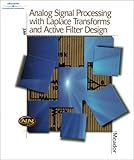
Analog Signal Processing with Laplace Transforms and Active Filter Design Review

Analog Signal Processing with Laplace Transforms and Active Filter Design
Average Reviews:

(More customer reviews)
This book gives a very good introduction to Laplace Transforms and Active Op-amp Filters. It highlights possible misstates a newbie might make. If you don't need a crash intro, I recommand purchasing a more advanced book on the appropriate topic.

Click Here to see more reviews about: Analog Signal Processing with Laplace Transforms and Active Filter Design

This book, written as an introduction to analog signal processing, offers examples that are worked in detail, showing step-by-step how to apply the techniques discussed within.In an effort to use current computing technologies, sections on how to work problems using MATLAB and the TI-89 hand calculator are given.Other topics covered include: basic equations for complex analog waveforms, Laplace transforms, Laplace circuit analysis, transfer functions for analog circuits, pole-zero plots, frequency response of analog circuits, filter specifications, frequency response characteristics of op-amps, and the design of Butterworth, Chebyshev, and elliptic active filters.

Buy Now

Click here for more information about Analog Signal Processing with Laplace Transforms and Active Filter Design

12/22/2011

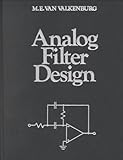
Analog Filter Design (The Oxford Series in Electrical and Computer Engineering) Review

Analog Filter Design (The Oxford Series in Electrical and Computer Engineering)
Average Reviews:

(More customer reviews)
(Reviewed by a practicing electrical engineer)This book is an excellent introductory text about analog filter design. It was written for use in teaching a junior-senior level undergraduate class at the University level.The book begins with a review of basic op amp circuits and then progresses to simple one-pole circuit designs. From there, the author builds a step-by-step theoretical background for active filter design, starting with the most fundamental two-pole building block (the biquad circuit), and then showing how to use these to design Chebyshev, Butterworth, and Bessel filter characteristics of any number of poles. Cauer, Inverse Chebyshev, and switched capacitor designs are also covered. Other highly useful chapters cover delay equalization, sensitivity to component variations, as well as a general design approach for choosing appropriate filter characteristics for a design requirement. The book's main focus is on active filter design using op amp's, although there is also one chapter devoted to passive filter design. Design is stressed in the examples and problems from the very beginning pages, as opposed to mere mathematical analysis. The mathematics are fairly straightforward, mostly algebra, and the text is fairly easy to read and follow. Examples illustrate each chapter segment, and each chapter has questions at the end. I would recommend this book for anyone seeking a basic theoretical understanding and design capability for active filters. (Probably other introductory texts would be better for passive filters.) This is not a "handbook" or "filter cookbook"; it actually lays the theoretical and mathematical groundwork for the filters it teaches you to design.

Click Here to see more reviews about: Analog Filter Design (The Oxford Series in Electrical and Computer Engineering)

This classic was the first to fill the need for an undergraduate text in analog filters for electrical engineering.Intended for juniors and seniors with a background in introductory circuits, including Laplace transforms, the text focuses on inductorless filters in which the active element is the operational amplifier (op-amp).Passive LCR filters are excluded except as prototypes from which an active equivalent is then found.Students learn the importance of op-amps to analog systems, which Van Valkenburg equates with the significance of the microprocessor to digital systems.Because the book is inteded for undergraduates, sophisticated mathematics has been avoided wherever possible in favor of algebraic derivations.Design topics require at most a hand-held calculator.

Buy NowGet 28% OFF

Click here for more information about Analog Filter Design (The Oxford Series in Electrical and Computer Engineering)

12/16/2011

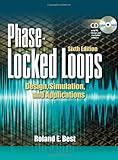
Phase Locked Loops 6/e: Design, Simulation, and Applications Review

Phase Locked Loops 6/e: Design, Simulation, and Applications
Average Reviews:

(More customer reviews)
This book is certainly worth owning. It is 1 of 7 PLL books that I own. I use it as a reference for the basic PLL linearized transfer functions even after I found that the transfer function for the 2nd order PLL with ideal integrator is incorrect.
Best covers analog PLLs with each block replaced by a digital implementation based on the incremental improvements made in standard TTL implementations of PLLs offered over the decades. This allows the reader to fully understand each digital block and the PLL in a way that is excellent for an introductory text.
The digital PLL is a numerical implementation of each PLL function, which has by definition an analog function. One way to implement such a numerical PLL is via replacing each analog function with the equivalent numerical function, without much focus on the Z domain and digital signal processing (DSP) concepts. That is what this book does. Look elsewhere for a book with heavy use of Z domain math (consider the Kluwer Acedemic Press Book 'Phase-Locked Loops for Wireless Communications: Analog and Digital' by Stephen (?) for more DSP math.
Best's approach is viable. I have personally designed a leading edge all-digital PLL, adding patent pending analog enhancements, and can asure the reader that straight-forward DSP approaches do not lead to the optimal designs, at least at the high data rates. Understanding of the PLL in analog form, and then adding the digital analogues is an excellent way to go. Best's book is surprisingly very different from Wolaver's book, almost orthogonal; start with Wolaver, then add Best if adding digital gates step by step to an analog PLL is of interest to you (it was to me).

Click Here to see more reviews about: Phase Locked Loops 6/e: Design, Simulation, and Applications


The Definitive Introduction to Phase-Locked Loops,Complete with Software for Designing Wireless Circuits!

The Sixth Edition of Roland Best's classic Phase-Locked Loops has been updated to equip you with today's definitive introduction to PLL design, complete with powerful PLL design and simulation software written by the author.
Filled with all the latest PLL advances, this celebrated sourcebook now includes new chapters on frequency synthesis…CAD for PLLs…mixed-signal PLLs…all-digital PLLs…and software PLLs_plus a new collection of sample communications applications. An essential tool for achieving cutting-edge PLL design, the Sixth Edition of Phase-Locked Loops features:
A wealth of easy-to-use methods for designing phase-locked loops
Over 200 detailed illustrations
New to this edition: new chapters on frequency synthesis, including fractional-N PLL frequency synthesizers using sigma-delta modulators;CAD for PLLs, mixed-signal PLLs, all-digital PLLs, and software PLLs; new PLL communications applications, including an overview on digital modulation techniques

Inside this Updated PLL Design Guide
• Introduction to PLLs • Mixed-Signal PLL Components • Mixed-Signal PLL Analysis • PLL Performance in the Presence of Noise • Design Procedure for Mixed-Signal PLLs • Mixed-Signal PLL Applications • Higher Order Loops • CAD and Simulation of Mixed-Signal PLLs • All-Digital PLLs (ADPLLs) • CAD and Simulation of ADPLLs • The Software PLL (SPLL) • The PLL in Communications • State-of-the-Art Commercial PLL Integrated Circuits • Appendices: The Pull-In Process • The Laplace Transform • Digital Filter Basics • Measuring PLL Parameters

Buy NowGet 30% OFF

Click here for more information about Phase Locked Loops 6/e: Design, Simulation, and Applications